Q3 2026 Delivery Results Report
Oct 02, 2026
Vietnam and China are among the world’s leading producers of sawdust charcoal (Ogatan), supplying restaurants, distributors, wholesalers, and BBQ businesses across Asia, Europe, the Middle East, and North America.
Although both countries manufacture compressed sawdust charcoal from hardwood sawdust, differences in raw materials, production methods, quality control, and carbonization processes can significantly affect the final product.
In this article, we compare Vietnamese and Chinese sawdust charcoal based on manufacturing characteristics, export experience, and real combustion testing to help buyers choose the most suitable product for their market.
For importers, selecting the right charcoal supplier involves more than comparing prices. Product consistency, burning performance, ash production, packaging quality, and long-term supply stability all have a direct impact on customer satisfaction.
Both Vietnam and China offer competitive products, but each origin has its own advantages depending on the intended application and target market.
Vietnam’s sawdust charcoal industry has grown alongside its large furniture manufacturing sector. Hardwood sawdust from species such as Acacia, Eucalyptus, Rubberwood, Longan, and Lychee is commonly recycled into high-density charcoal briquettes.
Many Vietnamese manufacturers focus on export markets, particularly Japan, South Korea, Europe, and the Middle East, where stable quality and consistent performance are highly valued.
China has one of the world’s largest charcoal manufacturing industries, with factories producing a wide range of products for different price segments.
Depending on the manufacturer, product quality can vary considerably. Some factories specialize in premium export-grade charcoal, while others focus on cost-effective products for high-volume markets.
| Criteria | Vietnam | China |
|---|---|---|
| Raw Material | Mainly recycled hardwood sawdust | Varies by manufacturer |
| Shape Consistency | Very consistent | Depends on factory |
| Heat Stability | Excellent | Good to Excellent |
| Burning Time | Long and stable | Varies by grade |
| Ash Production | Generally low | Depends on raw material |
| Smoke After Ignition | Very low | Varies by quality grade |
| Export Experience | Strong in Japan, Korea, Europe | Global export market |
| Quality Consistency | High among reputable exporters | Depends on supplier selection |
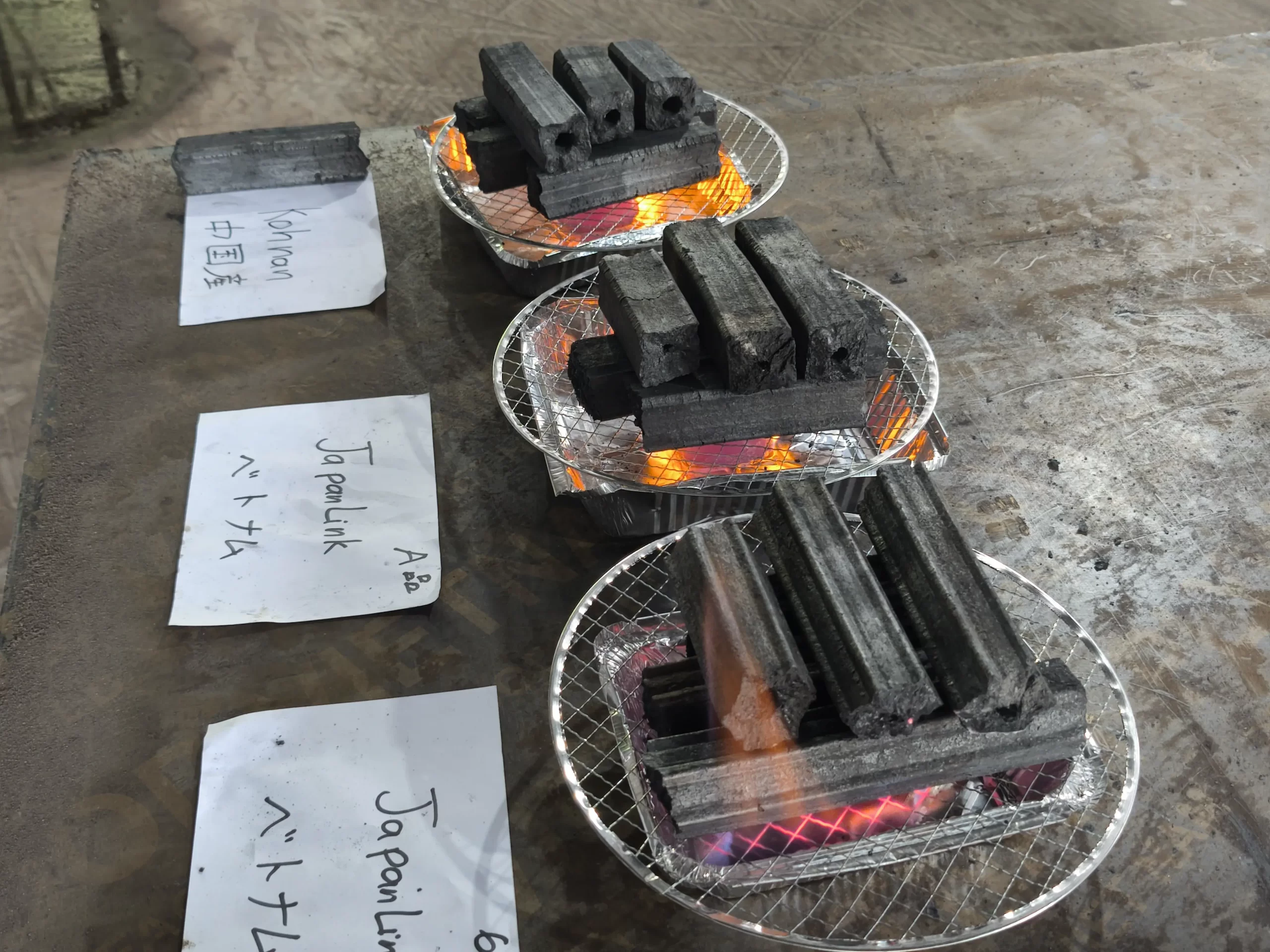
To provide a more objective comparison, we conducted a real combustion test using Vietnamese and Chinese sawdust charcoal under the same conditions.
The test compared:
Rather than relying only on laboratory specifications, this practical evaluation demonstrates how each product performs in actual BBQ and restaurant applications.
During our comparison, both products were capable of producing stable heat suitable for grilling and cooking. However, differences became more noticeable as the combustion process continued.
Vietnamese sawdust charcoal generally maintained a more consistent burning temperature with less visible ash accumulation throughout the test. The charcoal pieces also retained their original shape well during combustion.
The Chinese sample ignited efficiently and delivered good initial heat output. Depending on the production grade, burning performance and ash formation may vary between manufacturers.
As with any charcoal product, overall quality depends not only on the country of origin but also on raw materials, carbonization process, and factory quality control.
There is no universal answer because the best choice depends on your business objectives.
| If You Need… | Recommended Choice |
|---|---|
| Restaurant-grade performance | Vietnam |
| Long burning time | Vietnam |
| Stable quality for repeated orders | Vietnam |
| Entry-level budget products | China (depending on supplier) |
| Large product selection | China |
Instead of selecting a supplier based solely on country of origin, importers should evaluate actual product specifications, factory capabilities, quality control procedures, and sample performance before placing large orders.
No. Both countries manufacture high-quality products. Performance depends primarily on the individual manufacturer, raw materials, and carbonization process rather than origin alone.
Many restaurants value its consistent heat output, low ash content, and reliable quality for long cooking sessions.
Yes. Many Chinese manufacturers produce excellent export-grade charcoal. Buyers should compare technical specifications and request samples before purchasing.
Laboratory data is important, but practical combustion testing provides valuable insight into real-world performance. Evaluating both technical specifications and actual burning behavior is the most reliable approach.
Vietnam and China both play important roles in the global sawdust charcoal industry, offering products for different market segments and customer requirements.
For buyers seeking consistent restaurant-grade performance, stable combustion, and reliable export quality, Vietnamese sawdust charcoal has earned a strong reputation in many international markets. Meanwhile, Chinese manufacturers continue to provide a wide selection of products suitable for various applications and budgets.
Ultimately, choosing the right supplier should be based on verified product quality, technical specifications, real combustion performance, and long-term supply capability rather than country of origin alone.
Thank you for your continued support of Japan Link. Japan Link supports companies considering imports from Vietnam from start to finish, covering local...
Thank you for your continued support of Japan Link.We are pleased to report our delivery results for June 2026 and the first half of fiscal year 2026 below....

Oct 02, 2026
Oct 02, 2026
Oct 02, 2026
(0) Comments
Leave a Comment